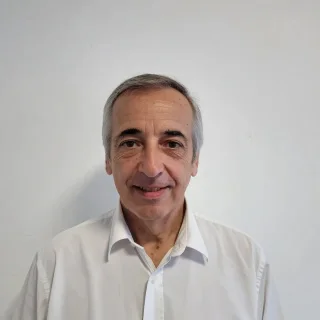
Concepción Martínez, known as Conchi, left her job as a forest firefighter in Madrid to start a venture in Bustarviejo. Today, she is a cheese master at La Caperuza, a project that focuses on extensive livestock farming and direct sales of dairy and meat products.
Fifteen years ago, Concepción Martínez, Conchi, made a decision that would change her life. A forest firefighter in the capital, she chose to move to Bustarviejo, a municipality in the Sierra Norte of Madrid with fewer than 3,000 inhabitants. There, along with two partners, she founded an extensive livestock farm that eventually became La Caperuza, an artisanal cheese shop that now produces cheeses and yoghurts using milk from her own flock.
“I have always loved the countryside. Every weekend I would go to the mountains to see the valleys and the villages in the region,” Conchi recalls. “As a mother, I decided that the city was not where I would raise my children. I wanted different rhythms, other advantages.” Although she continued for several months in the fire department, she soon realised that she needed to step aside and change her professional trajectory.
The turning point came when she observed the resources in the village. “Seeing the resources available in the village, we decided to start a venture by setting up an extensive livestock farm,” she explains. The initiative was supported by the region's livestock farming tradition. “This village has always had a strong livestock presence, although it had disappeared in recent years. We added to this the possibility of accessing public land from the livestock organisation. We started with a pretty good foundation because it reduced our inputs, which were largely the vegetation itself.”
The project, which started with a few animals, has grown to nearly 250 heads of livestock. For Conchi, it was crucial to study market prices and the economy of the sector in Spain. “We aimed to revalue the product and be as independent as possible,” she states. Thus, the cheese shop was born, opening its doors in 2015.
However, the path was not easy. The two initial partners distanced themselves from the project “due to lack of income.” It was then that Laura, a veterinarian by profession, joined to handle the livestock aspect. Conchi, for her part, leads the product transformation. “I have trained in dairy production, regulatory issues, and hygiene standards. I am the cheese master of Bustarviejo. We make various types of cheeses and yoghurts, using both lactic and enzymatic coagulations,” she details.
La Caperuza not only sells its products but also organises open days to showcase sustainable production. “When you show people what it costs to produce a litre of milk or that it takes seven litres of milk to make a single cheese, which also needs to be fairly priced, they understand the importance,” Conchi points out.
The flock, grazing in semi-freedom, also contributes to preventing forest fires by removing dense vegetation. “It’s about giving back rather than taking away, producing something that minimises the footprint we may leave on the planet,” she emphasises.
For Conchi, the project represents a commitment to food sovereignty. “Small farmers are disappearing, and every day fertile land that feeds us is being lost. Crops are turning into solar farms or wind turbines. People are unaware that we are losing national food sovereignty, which used to be significant. More and more products come from abroad. When farmers and livestock breeders disappear, we will have a problem,” she warns.
Conchi and Laura are examples of women working in the primary sector, a traditionally male-dominated field. “Women in agriculture have always existed,” Conchi asserts, encouraging others to venture into rural areas. La Caperuza continues to grow, aiming to consolidate a production model that respects the environment and brings consumers closer to the real value of food.